Melanochromis
parallelus – The Parallel Striped Mbuna
Burgess & Axelrod (1976)
The common name of this Malawian cichlid is a good example of why the
fish got its scientific name. Parallelus is taken from the Greek
“parallelos”. Taking the meaning of parallelos further, it’s literally
from “para allelois” which means ‘beside one another’ (para "beside" +
allelois "each other,"). Females and juveniles of this fish have 2
symmetrical black horizontal lines running down the length of its body.
The bottom line runs approximately at mid-body and the top stripe is
almost at the top of the body. All of the unpaired fins
are edged in black (though the markings on the tail are not
continuous). The body colour itself is generally white. Males
seem to almost reverse their colouration, except in that the females
are black and white, the males are black and blue. Where the female is
black, the male is blue. Where the female is white is the male shows
black. Adults range
in size from 11-13 cm (4 ½-5”).
All of the unpaired fins
are edged in black (though the markings on the tail are not
continuous). The body colour itself is generally white. Males
seem to almost reverse their colouration, except in that the females
are black and white, the males are black and blue. Where the female is
black, the male is blue. Where the female is white is the male shows
black. Adults range
in size from 11-13 cm (4 ½-5”).
This cichlid occurs on the
northwestern part of the lake from Kande Island to Mpanga Rock; from
Mara Point to Lutura reef; Likoma Island and Chizumulu Island in Lake
Malawi. It’s been introduced to Cape Maclear, Lake Malawi. They tend to
occupy a niche 2-28 m.(6-92’) deep.
Melanochromis parallelus is
omnivorous in the wild, generally dieting on invertebrates but on
occasion unusual feeding habits appear. This is remarked by Ad Konings
in one of his books and I’ve quoted it to fully explain the behaviour.
M.
parallelus and M. vermivorus
are both found in the sediment-free rocky habitat and show distinct
sexual dichromatism. These two species, although more numerous than the
previous one, are likewise omnivores which feed primarily on
invertebrates but nip from the biocover as well. When plankton is
abundant they also join with other mbuna in feeding in the water
column. A diver may attract several of them when debris is stirred up
by his fins. Both species feed opportunistically, but I have observed another, most remarkable type
of feeding behaviour in M. parallelus.
Eccles and Lewis (1976) describe the cleaning behaviour of juvenile Docimodus evelynae which feed on
the fungus and parasites attached to larger haplochromines. After the
rainy season, which is an important breeding period for many species,
several larger haplochromines have damaged fins or scales. These wounds
are covered with fungus which prevents rapid healing. On several
occasions I have observed adult females of M. parallelus picking fungus from
larger haplochromines. In all instances the wounded fish approached the
cleaner and made clear, by lying on its side or hovering in a slanting,
head-up position, that it would like to have a treatment. In all cases
the dorsal fin was presented first. The female Parallelus then picked vigorously
at the fungus and tore it off. Although it visibly hurt the client it
remained in the typical position. When all its wounds were cleaned,
which might take more than a minute, the larger haplochromine would
resume its normal position and disappear. Cleaning stations, as seen in
marine fishes, were not observed: after the job was done the female Parallelus would disappear from the
scene as well. George Turner (pers. comm.) once found a juvenile M. auratus with a cleaning station
based around a small rock at the edge of a breeding colony of a Copadichromis species. Several
utaka and rock-dwelling species have been observed being cleaned, but
in all instances these were large haps, never mbuna. — Konings, A.
2001. Malawi cichlids in their natural habitat. 3rd ed. . Cichlid Press
page 99.
Aquarium keeping of M. parallelus
is not too difficult if a few things are kept in mind. This fish is NOT
for beginners to Malawian cichlids. You will need a large tank
that has a lot of hiding places in it. It is highly aggressive,
especially to its own kind. Even the 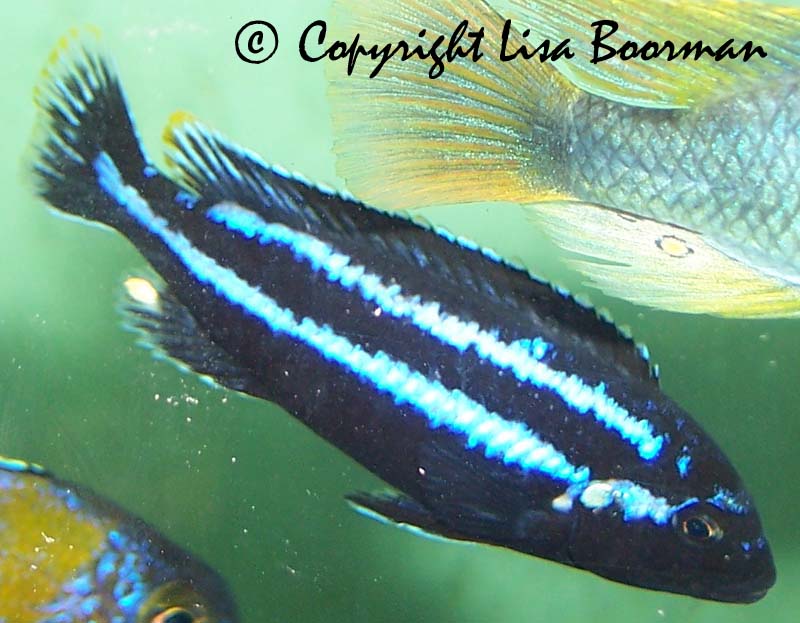 females can be very aggressive
to each other. For this reason, you should keep a fairly large group
(5-6+) of these cichlids together. The best arrangement is 1 male and
all the rest female. Dominant males will chase and harass subdominant
males.
females can be very aggressive
to each other. For this reason, you should keep a fairly large group
(5-6+) of these cichlids together. The best arrangement is 1 male and
all the rest female. Dominant males will chase and harass subdominant
males.
I received these young fish from Spencer Jack at the 2005 ACA in
Chicago. I purchased 10 juveniles that were around 2” SL long. I
originally kept them in a small tank to get some size on them. Once
they reached about 3” SL I felt they were big enough to go into my
large 225g cichlid tank. They fit into the tank quite well. Even at
this size there was no differentiating any sexes on these fish. I
expected some sort of colour change soon since my M. johannii had gone
through their transformation at around this size.

I kept waiting for signs of
what sexes I had. Instead all they did was chase each other around and
all kept looking like females. It took over a year before I noticed any
colour changes in them. I suspect it was the fact that they were the
smallest fish in the tank rather than anything else that kept their
colour change from happening any earlier. Finally I started
seeing a few of the parallelus showing hints of blue on their sides.
This process seemed to take forever as well. From the day I started
noticing a little
bit of blue on a couple of fish until I noticed a completely obvious
male there was no gradual colour change on the males. One day it seemed
was a white and black fish with blueish tints on it, the next a blue
and black fish!
I was excited now since I knew for sure that I most likely had both
sexes available in the big tank. Now it was just a matter of waiting.
And wait again I did…..
Finally about 2 years from when I got them I got a good-sized spawn of
fry. I stripped the first female that I saw holding. Within days of
that event there was another female holding. Since I already had more
than enough fry from the first female, I did not bother saving the fry
from the other female. These fry were placed into a 10 gallon tank to
start their life. They were kept with a few Haplochromis sp. ‘blue
back’ fry and some King Tiger plecos I’m growing out. I was a bit
worried about the Hap fry but so far they’ve been safe
(even with the size difference). They were fed crushed flake mainly
along with treats of bbs and microworms. They grow fairly quickly. I
have placed them into larger quarters until I can pass around the fry.
I enjoyed these fish even if they did take forever to spawn. They are a
very distinctive colour and you cannot miss them in their tank.
If you have the room, and have a little experience with Malawians, why
not give them a try?
©
Copyright Lisa Boorman
All Rights
Reserved
Suggested Reading:
Malawi
Cichlids in their natural habitat - 3rd edition Ad Konings
Fishkeepers
Guide to African Cichlids by Paul Loiselle
The
Cichlid Aquarium by Dr. Paul Loiselle
Success
with Cichlids from Lake Malawi & Tanganyika by Sabine Melke, U.
Erich Friese
Baensch
Aquarium Atlas vol. 2 by Dr. Rüdiger Riehl & Hans A.
Baensch
Guide
to Malawi Cichlids (Back to Nature) by Ad Konings
Enjoying Cichlids by Ad
Konings (editor)
Offshore
Cichlids of Lake Malawi by George F. Turner
To see more references on
cichlids:
Cichlid Book List
Back to Main Page